
Our Native Honeybee Project at Fujairah Research Centre
One of the most fascinating things about working with our local honeybee, Apis mellifera jemenitica, is seeing how efficiently they find resources in an environment that often appears challenging to us.
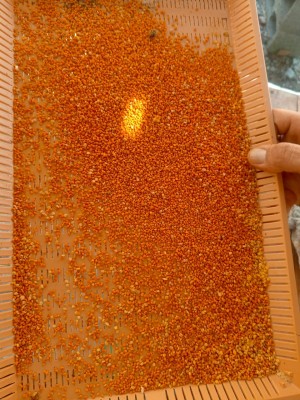
These pollen samples were collected over just a few days from two apiaries located approximately 10 km apart. At first glance, the surrounding landscape may seem similar, especially during the hot season when visible flowering is limited. Yet the bees tell a very different story.
The pollen traps revealed an impressive diversity of pollen colors and types, indicating that the colonies were foraging on a wide range of plant species.
What is particularly interesting is that the pollen composition differs noticeably between the two locations. Even within a relatively small geographic area, the bees are identifying and utilizing different floral resources, reflecting the rich and often overlooked diversity of the local environment.
In one location, the pollen loads were dominated by bright orange pollen, while the second site showed a much more mixed composition with several distinct pollen types. This highlights how bee colonies adapt their foraging strategy to the resources available around them.
Why does this matter?
• It demonstrates the remarkable ability of honey bees to locate and exploit floral resources that may go unnoticed by people
• It highlights the hidden plant diversity present across the landscape
• It provides insight into the nutritional resources available to colonies throughout the season
• It showcases the efficiency of our native bees under hot and arid conditions
Perhaps the most impressive aspect is that these collections were made during a period of high temperatures, when many people would assume there is little forage available. Despite the challenging conditions, the bees continued to bring back substantial amounts of pollen from multiple sources.
This is one of the strengths of our native honey bee, Apis mellifera jemenitica. Having adapted to the region's climate over thousands of years, these bees are exceptionally skilled at locating and utilizing resources efficiently, even when conditions appear unfavorable.
Every pollen pellet tells a story about where the bees have been, what plants are supporting them, and how closely connected they are to the local ecosystem.