
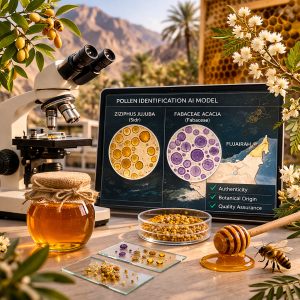
From Flower to Fingerprint: How Two Key Plant Species Shape Honey Authentication in Fujairah
Honey is more than a natural sweetener. It is a direct reflection of its environment. The key to unlocking this connection lies in pollen. Each pollen grain found in honey acts as a microscopic fingerprint, revealing the floral origin and ensuring authenticity. This makes pollen analysis not just important, but essential in protecting honey quality and consumer trust.
In the UAE, and especially in Fujairah, this becomes even more critical. The region is known for producing high-value honey, particularly from two key plant species: Ziziphus jujuba (Sidr) and Acacia species (family Fabaceae). Sidr honey is widely recognized for its medicinal properties and premium status, while Acacia honey is valued for its distinct characteristics and consistency. Because of their economic and cultural importance, accurately identifying these floral sources is vital.
Fujairah’s unique landscape, rich in native flora and shaped by mountains and wadis, makes it an ideal environment for these species to thrive. This means that honey produced here carries a strong regional identity. Protecting that identity requires scientific validation, especially in a market where mislabeling or adulteration can occur.
This is where the Fujairah Research Centre (FRC) becomes highly relevant. By combining traditional microscopy with advanced AI technology, FRC has developed a pollen identification model supported by a comprehensive local pollen library. Ziziphus jujuba and Acacia pollen are key components of this system, allowing for rapid and accurate classification of honey samples.
Through this integration of science and innovation, FRC is strengthening honey authentication in the UAE. It ensures that products labeled as Sidr or Acacia are genuinely derived from those sources, supporting beekeepers, protecting consumers, and preserving the reputation of Fujairah’s honey.
Ultimately, pollen is more than just a scientific detail. It is the foundation of authenticity. By understanding and identifying it, Fujairah is not only safeguarding its natural resources but also leading the way in combining tradition with technology.